
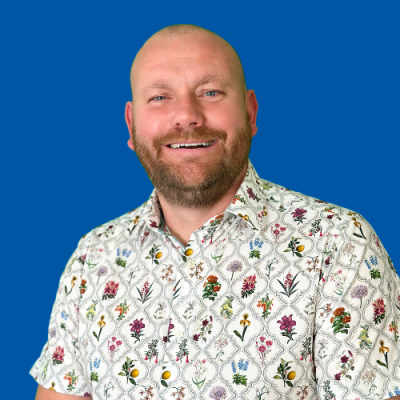
Each month we meet key stakeholders and business leaders in the social care sector. This month we meet Gareth Williams, the founder of Memory Makers, a UK social-purpose organisation combining a simple app with a human-led approach to help care settings capture and preserve people’s stories.
Memory Makers’ mission is about preserving voices and creating legacies. What inspired this focus on storytelling as a tool for care and connection, especially in care home environments?
For me, it comes back to how I was brought up. I grew up around respite care, so I saw first-hand what good care looks like – dignity, fairness, and treating people properly.
Memory Makers is built on that same idea – that people should be seen properly, valued properly, and remembered properly. In care settings, people can sometimes become known through their needs rather than who they are.
Every resident has a whole life behind them – countless stories, relationships and memories. Storytelling brings that back into the room and helps people be known as a person again.
How does your platform support care teams and families in capturing meaningful stories while ensuring the process feels calm, human, and authentic?
We’ve always said this shouldn’t feel like a system people have to learn. Care teams don’t need more pressure, and families don’t want something formal. Everything is built around what people already do daily – conversation. The prompts are there if needed, but really it’s about sitting down and talking, then capturing that simply. It doesn’t have to happen all at once either. It can be small moments over time, which makes it realistic in a care setting. For families, it makes a real difference. Being able to see or hear those moments helps them feel closer and more reassured.
Can you share an example of a moment or story that really demonstrated the impact Memory Makers has had on a resident, family, or care team?
At its core, Memory Makers is just one person sitting with another and talking about their life – something we all do anyway. But in care, that space doesn’t always get protected.
In one setting, a resident shared memories that staff and family hadn’t really heard before. It wasn’t staged, just a conversation. But it changed things. Staff engaged differently, and the family felt they’d been given something to hold onto. Then other residents wanted to share too.
That’s when you see the impact and the ripple effect just one question can have in a room full of people bursting with memories waiting to be revived and relived.
Preserving memories can be deeply emotional work. What challenges have you encountered in helping organisations adopt legacy recording, and how have you overcome them?
The hesitation is usually around time and sensitivity. People worry it will add pressure, or feel too emotional for families.
What we’ve found is that, when it’s introduced properly, it doesn’t feel heavy at all. With clear consent, a bit of structure and the right support, it becomes part of meaningful engagement rather than something extra.
Once teams see that, the mindset shifts. It stops feeling like an additional task and starts to feel like something that naturally sits alongside good care.
As a leader, what have you learned about balancing technology and human connection when developing tools that are used by care professionals and families alike?
The main thing I’ve learned is that the technology should never be the focus. If people are thinking about the app more than the person in front of them, then we’ve got it wrong. The role of the technology is to make it easier to capture what’s already happening – not to lead it. Ideally, it almost disappears. It supports the conversation, keeps things safe, and then gets out of the way. Because in care, but also in the sharing of any memory, that human connection isn’t an add-on, it’s the whole point.
Looking ahead, what are Memory Makers’ key priorities or innovations for 2026 – especially in how care settings use your platform to enhance wellbeing and connection?
For us, 2026 is about making this work in a way that’s genuinely sustainable for care settings. That means continuing to simplify how stories are captured, making it easier for families to stay connected and helping providers show the value of person-centred care.
As an organisation, we’re working towards capturing one million memories over time because each one represents a person whose story might otherwise be lost. Alongside that, there’s a focus on culture – helping teams feel more connected and bringing more meaning into everyday care.
Gareth Williams, Founder, Memory Makers