
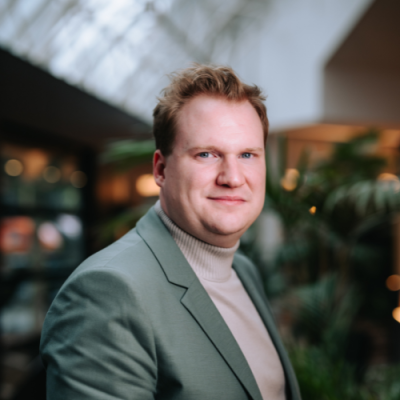
Each month we meet key stakeholders and business leaders in the social care sector. This month we meet Jan-Willem Callebaut, the Managing Director of Nobi UK & Global Markets, AI-powered smart ceiling lights that help older people stay safe and independent by detecting and preventing falls, automatically alerting carers or family members, and providing health and activity insights for care teams.
Nobi is positioning itself as more than a product- how do you see the company evolving from a smart lighting solution into a broader platform for proactive healthcare?
One of the starting points for Nobi was very simple. We took an everyday object, the ceiling light, and made it smart by adding computing power. Because lighting is already present in every room and fully accepted by residents and staff, technology can be introduced naturally, without changing behaviour first.
What follows is that the use cases expand. It may begin with visibility into falls, but quickly moves into understanding movement, sleep and changes in routine, alongside insight into how care is delivered in practice. Because everything sits on the same infrastructure, additional functionality can be added over time, turning the light into a long-term infrastructure layer for care environments.
What role do partnerships play in strengthening Nobi’s value proposition?
Partnerships are mainly about ensuring the technology fits into existing ways of working. Care teams already rely heavily on electronic care record systems such as Nourish and Person Centred Software, so if insights sit outside those systems, they are less likely to be used consistently. Integration allows information from Nobi to become part of daily workflows rather than something additional.
How do you measure success beyond fall detection – what outcomes matter most to your customers and to Nobi’s mission?
Falls are often the entry point, but they are only one part of the picture. Providers typically focus on reducing falls and improving response times, both of which directly affect outcomes. In a recent independent study across 74 care homes in Lancashire and South Cumbria, covering more than 900 residents, results showed around a one-third reduction in falls and average response times below three minutes.
There is also growing interest in indicators such as mobility and sleep, which can signal changes earlier. Operationally, clearer insight supports more consistent decision-making, while automated incident capture reduces reporting time and allows care teams to spend more time delivering care itself.
With ageing populations increasing globally, how do you see the role of AI-driven ambient monitoring shaping the future of senior care over the next 5–10 years?
There is a growing expectation that technology will help address staffing and demand pressures across the sector. One challenge is fragmentation, with many providers using systems that do not integrate well, limiting the value of the data they generate. More integrated approaches can create a more complete picture and better insight over time.
At the moment, most systems help teams understand what has happened. Increasingly, they are expected to support earlier intervention and more informed decision-making.
What differentiates Nobi most clearly from other ambient assisted living or fall detection solutions in the market?
One difference is that the system does not rely on consistent action from residents. Wearables and call buttons can be effective, but they are not always used reliably in more complex care settings. By embedding technology into the environment, that dependency is reduced. Multiple use cases also sit on the same system, including falls management, nurse call and care insights, allowing incidents to be reviewed in detail while supporting quieter, more efficient workflows.
How do you ensure data privacy while still extracting meaningful insights from continuous monitoring?
Privacy is a central consideration in these environments. The system is designed to provide useful insight while limiting unnecessary exposure. In practice, images are not part of daily workflows and are only accessed in the context of an incident. They are retained for a limited period, typically up to 14 days, after which they are deleted, including from Nobi’s servers. At the same time, providers can configure the system in line with their own policies and consent frameworks.
What role do you think companies like Nobi should play in shaping public policy around ageing and independent living?
There is a clear need to connect innovation with real-world outcomes. Many ideas in this space are promising in theory, but more evidence is needed on what works in practice and at scale.
By working closely with care providers, it becomes possible to generate that evidence and feed it back into the broader discussion. That is likely where Nobi UK can add the most value.
Jan-Willem Callebaut, Managing Director of Nobi UK & Global Markets