
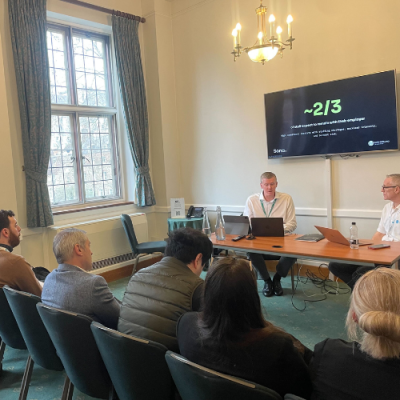

A recent seminar briefing warned that the adult social care sector is currently being sustained by ‘workforce goodwill’ rather than resilient operational systems.
The event, hosted by Sona and Care England, explored the findings of an extensive research report involving 318 care professionals and 10 in-depth C-suite interviews. Led by Paul Watson, VP at Sona, and Richard Ayres, Social Care Advisor, Care England, the discussion moved beyond statistics to share the real version of how services are coping under sustained structural pressure.
The conversation revealed services often appear fully staffed on a spreadsheet while remaining fundamentally unstable on the ground. This fragility stems from a lack of built-in ‘slack’ required to handle rising care acuity or unpredictable absences, leading to nearly 49% of providers being short-staffed at least some of the time.
To maintain basic service safety, 54% of providers have been forced to adopt overtime as their primary operating model. This systemic strain is further compounded by a persistent visibility gap, as 80% of organisations continue to lose vital time to fragmented manual processes and administrative friction, making it difficult to address pressures before they become crises.
Paul Watson commented during the briefing: “The data shows a sector being held together by incredible people, but the infrastructure needs to catch up. Nearly half of providers are short-staffed at least some of the time and when we see 54% relying on overtime as a default, it’s clear that resilience is currently carried by individuals rather than systems.”
Perhaps the most complex finding discussed was the ‘loyalty paradox’, the fact that despite these intense pressures, roughly two-thirds of staff expect to remain with their current employer. While this commitment is a testament to the professionalism of the workforce, leaders cautioned that mistaking personal goodwill for systemic stability creates a significant, hidden long-term risk for the sector.
The path to genuine resilience lies in shifting from reactive ‘firefighting’ to proactive design, with digital maturity identified as the strongest controllable force for stability. By moving away from manual processes, providers can gain the visibility needed to identify staffing gaps days in advance, allowing them to support their teams more effectively and focus on delivering high-quality care.
Richard Ayres, Care England, added: “Providers are continuing to deliver high-quality care, but they are often absorbing the gap between commissioned funding and actual delivery costs. We must shift from simply coping with pressure to designing resilience into how services operate.”
The seminar concluded with a challenge to sector leaders to evaluate whether their organisations are truly resilient or simply relying on staff to work through breaks and pick up the slack.
For further information, the full report remains available for download on the Sona website. Visit, https://www.sona.ai/resources/adult-social-care-insights-report
From left: Paul Waston, VP at Sona and Richard Ayres, Social Care Advisor, Care England